What Is Dry Needling for TMJ? How Long It Lasts and Aftercare
You may have heard a dentist, a friend, or an online forum mention dry needling for TMJ. At first, the idea of needles near your jaw can sound strange. So what is it, how long does it last, and what should you do after a session? This guide answers those three questions in plain language. It draws on what Dr. Evelyn Mora, PT, DPT, sees every day in a practice that treats only TMJ and facial pain.
TL;DR: Dry needling for TMJ uses thin, sterile needles to release tight spots in jaw muscles like the masseter and lateral pterygoid. Relief often builds over several sessions. It also tends to last longer when you address habits like clenching and poor posture. Afterward, gentle movement, water, heat, and soft foods for the day help the muscles settle.
What Is TMJ Pain? Understanding the Root Causes
TMJ pain refers to discomfort in the temporomandibular joint, the hinge connecting your jawbone to your skull, often caused by muscle tension, inflammation, or imbalance rather than the joint itself being structurally damaged. Common symptoms include jaw stiffness, clicking or popping, headaches, neck pain, and difficulty chewing.
Dr. Evelyn Mora, PT, DPT, evaluates each patient to see whether symptoms come mostly from muscle tension, such as clenching or bruxism, or from the joint itself. That difference shapes whether dry needling is likely to help and how it fits into a broader plan.
What Is Dry Needling for TMJ?
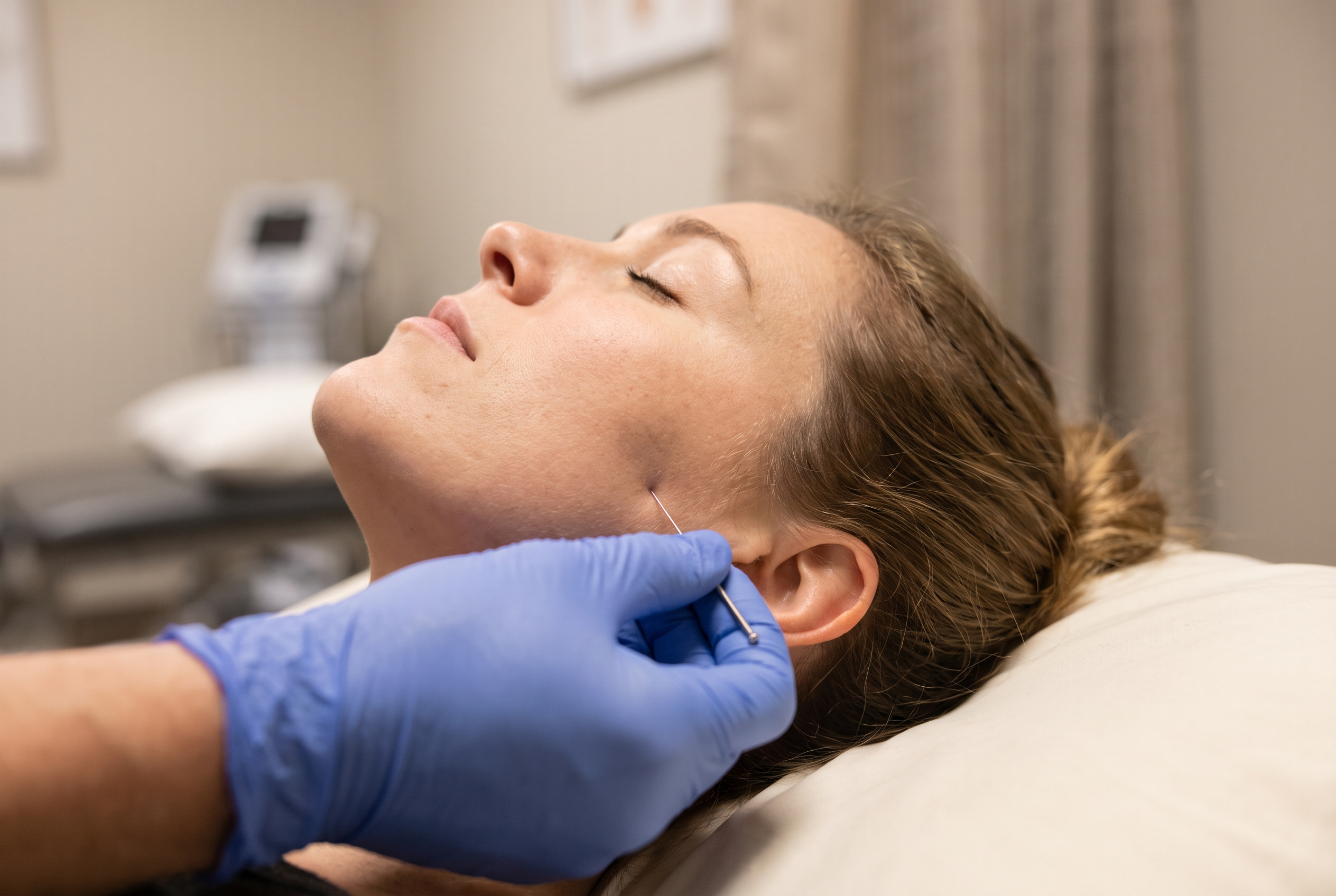
Dry needling places thin, sterile needles into trigger points, which are tight bands inside a muscle. The goal is to release that tension and help the muscle relax. The main difference from acupuncture is the basis behind it. Dry needling targets muscle tension spots found through modern anatomy, not traditional energy pathways.
By stimulating these trigger points, dry needling helps release muscle knots, improve local blood flow, and prompt the body’s natural pain-relieving response through nerve pathway activation. For TMJ pain specifically, this means addressing the muscular tension contributing to jaw stiffness and discomfort directly, rather than only managing the resulting pain.
Masseter and Lateral Pterygoid: The Jaw Muscles Dry Needling Targets
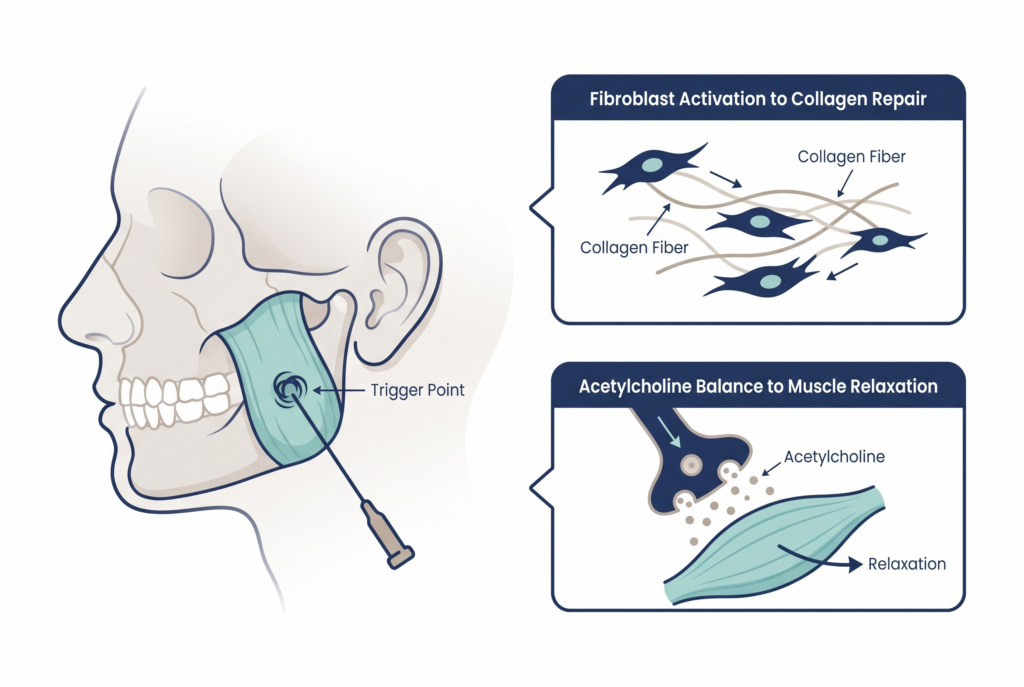
Dry needling works by targeting the muscles most often behind jaw tension, mainly the masseter and lateral pterygoid. When these muscles stay chronically tight, they place ongoing pressure on the temporomandibular joint itself, contributing to pain and restricted movement.
The masseter plays a central role in chewing and biting force, while the lateral pterygoid controls jaw opening and side-to-side movement. Because these two muscles serve different functions, both often need to be addressed for meaningful improvement, and the lateral pterygoid in particular sometimes requires an intraoral (buccal) approach to reach effectively.
The Science Behind Relief: Fibroblasts, Collagen, and Acetylcholine
Dry needling supports TMJ pain relief through two underlying biological mechanisms: fibroblast activation and neurotransmitter regulation. Fibroblasts are the cells responsible for producing collagen, and stimulating them supports repair of the connective tissue around jaw muscles that chronic tension can wear down over time.
The treatment also influences acetylcholine, a neurotransmitter that governs how muscles contract and relax. When acetylcholine activity is out of balance, muscles struggle to fully release tension. Dry needling helps restore that balance, which is part of why chronically tight jaw muscles are often able to relax more fully after treatment rather than only temporarily.
How Long Does Dry Needling Last for TMJ?
How long dry needling lasts varies by patient, but many notice initial improvement within a few sessions, with more pronounced and lasting relief building over the course of a full treatment plan. Some soreness or mild bruising at the needle site is common and typically resolves within a day or two.
Relief tends to last longer when contributing factors, like clenching, poor posture, or bite alignment, are addressed alongside the needling itself. Treating dry needling as one part of a broader plan, rather than a standalone fix, generally produces more durable results than repeated isolated sessions.
Integrating Dry Needling With Other TMJ Therapies
Dry needling works best as one component within a broader TMJ treatment plan rather than a standalone solution. Combining it with other targeted therapies addresses the multiple factors, muscular, postural, and behavioral, that typically contribute to TMJ pain.
At Florida TMJ Physical Therapy Center, dry needling is often paired with targeted exercises to reinforce newly relaxed muscles, postural correction to reduce ongoing strain on the jaw, and stress management strategies to curb unconscious clenching. When bite alignment or grinding is a contributing factor, collaboration with a dentist for a mouthguard or bite adjustment may also be recommended alongside physical therapy.
If you want to see how our team builds this into care, visit our page on dry needling for TMJ in Pembroke Pines. You can also browse our full range of TMJ treatment services.
Dry Needling vs. Other TMJ Pain Approaches
| Approach | Addresses Muscle Tension Directly | Non-Invasive | Supports Long-Term Muscle Repair | Typical Use Case |
| Dry Needling | Yes | Yes | Yes | Muscle-driven TMJ tension |
| Manual Therapy Alone | Partial | Yes | Partial | Mild to moderate tension |
| Night Guard / Appliance Alone | No | Yes | No | Bite-related grinding |
| Pain Medication Alone | No | Yes | No | Temporary symptom relief only |
Is Dry Needling Safe for TMJ?
Dry needling is considered low-risk when performed by a trained physical therapist, with most side effects limited to mild soreness or slight bruising at the needle site that resolves within a day or two. A thorough evaluation, including a review of conditions like pregnancy or blood-thinning medication use, helps determine candidacy before treatment begins.
Ask About Dry Needling for TMJ
When the muscles around your jaw, neck, and shoulders stay locked in tension, stretching alone often isn’t enough to settle them down. Dry needling targets those trigger points directly, and Dr. Evelyn Mora uses it alongside hands-on therapy and exercise as part of one individualized plan. If you’re curious whether it fits your case, an evaluation is the place to start.
Frequently Asked Questions About Dry Needling for TMJ Pain
Most patients describe a mild pinch or pressure as the needle enters, which fades quickly. Some areas, particularly deeper muscles like the lateral pterygoid, may feel more tender, though the sensation is generally manageable.
This varies by patient, but many notice initial improvement within a few sessions, with more complete relief building over a full course of treatment. An evaluation helps set a more specific expectation.
Mild TMJ symptoms can benefit from early intervention, which may help prevent the tension from escalating into more persistent or harder-to-treat pain over time.
No. Dry needling targets scientifically identified muscle trigger points based on Western neuromuscular anatomy, while acupuncture is rooted in traditional Chinese medicine and focuses on energy pathways.
Avoiding intense physical activity and excessive jaw use, like chewing tough foods, for the rest of the day supports the treated muscles as they settle. Gentle movement and hydration are generally encouraged instead.
Certain conditions, such as pregnancy or blood-thinning medication use, may affect candidacy. A thorough evaluation helps determine whether dry needling is appropriate for your specific health history.