How TMJ Disorder Treatment Eases Facial Pain
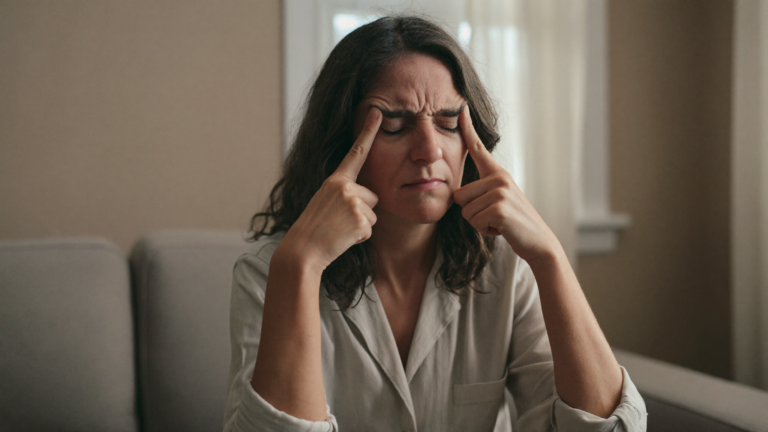
The ache does not stay in one place. Some days it sits along your cheek, some days under your ear, and some days it feels exactly like a bad tooth that no dentist can find anything wrong with. Chewing a bagel makes it worse. So does a long phone call, or a stressful week at work. Facial pain that moves around like this is confusing precisely because it does not behave the way most people expect pain to behave, and it rarely responds to the remedies that work on an ordinary ache. TMJ disorder treatment starts from a different premise: that the joint and muscles moving your jaw are the source, and your face is simply where they send the signal.
TL;DR: Facial pain, cheek soreness, and ear-area discomfort are often referred to as pain from overworked jaw muscles rather than problems in the face itself. TMJ disorder treatment through physical therapy targets those muscles, the joint’s movement, and the postural strain feeding both. A hands-on evaluation is what determines which of those three is actually driving your symptoms.
What Causes TMJ and Orofacial Pain?
TMJ and orofacial pain is discomfort felt in the jaw, cheek, temple, or ear region that originates in the temporomandibular joint or the muscles that move it. It develops from muscle overload, joint irritation, arthritis, bruxism (teeth grinding and clenching), or sustained postural strain, and it frequently refers pain into areas that feel entirely unrelated to the jaw.
That referral pattern is the part most people never hear explained. Dr. Evelyn Mora, PT, DPT, who has trained specifically in TMJ disorders and craniofacial pain, points out that jaw muscles send pain along predictable maps rather than along the nerve distributions patients expect. The masseter refers to the cheek and toward the upper and lower molars, which is why so many patients arrive after a dental workup that came back completely clean. The temporalis refers to the temple and the upper teeth. The medial pterygoid refers deep toward the ear and throat, producing the fullness and earache that sends people to an ENT first.
Once you know those maps, a “mystery” facial pain often stops being mysterious. The tooth that aches without decay, the ear that feels blocked without infection, and the cheek that burns after a long meal can all trace back to the same overworked muscle group. Many of the symptoms people rarely connect to the jaw fall into exactly this category.
How TMJ Disorder Treatment Takes a Comprehensive Approach
Comprehensive TMJ disorder treatment evaluates three things together: the joint itself, the muscles that move it, and the cervical posture supporting both. Findings from that evaluation shape a plan that combines manual therapy, targeted exercise, and supporting modalities, rather than applying one standard protocol to every patient who walks in with facial pain.
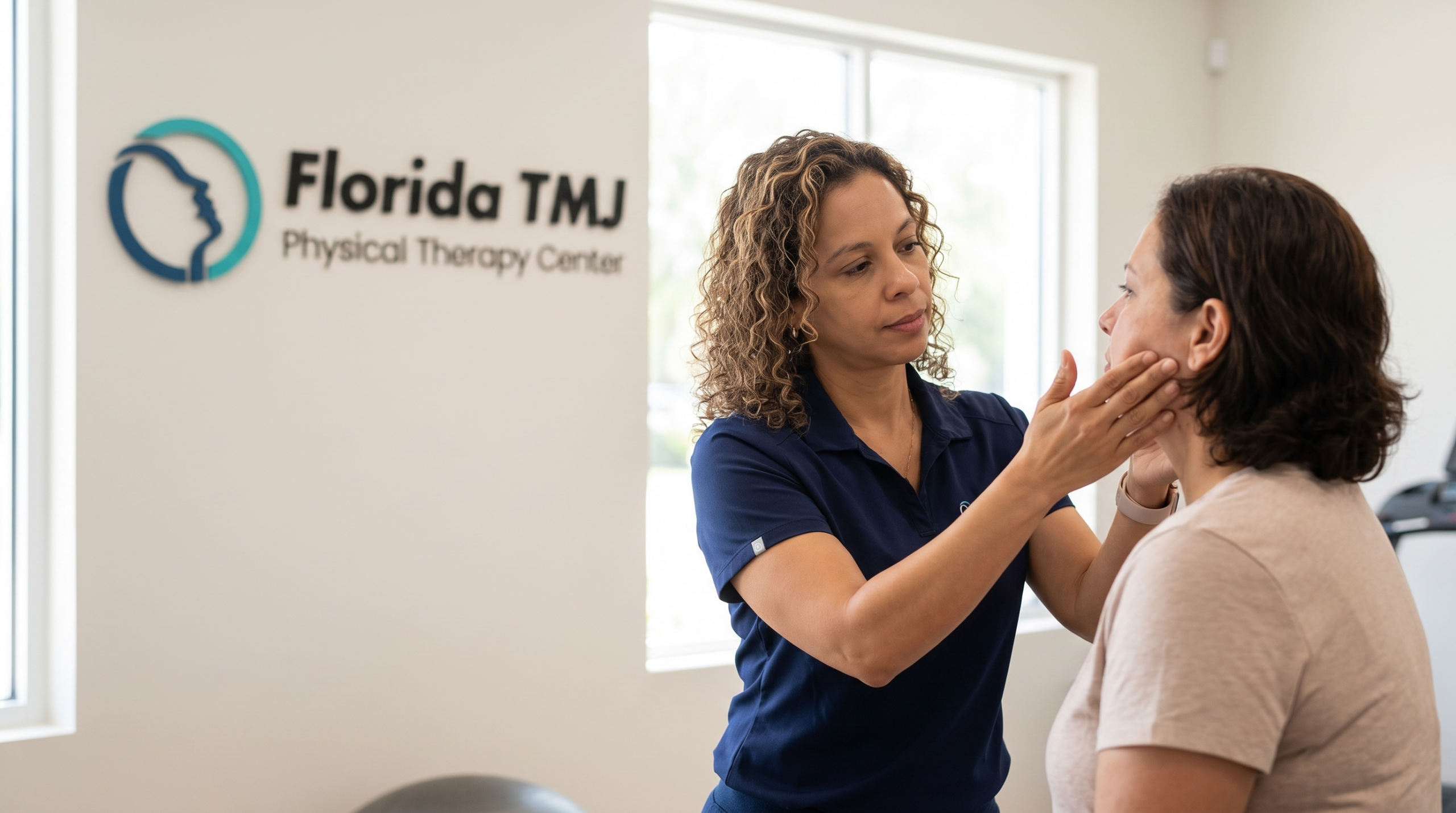
In practice, Dr. Mora’s evaluation measures maximal mouth opening in millimeters, watches whether the jaw travels straight or drifts to one side as it opens, palpates the masseter, temporalis, and both pterygoids for reproducible tenderness, and screens upper cervical mobility at C1 through C3. That last step matters more than it sounds: the upper cervical segments converge with the trigeminal nerve, so a stiff neck and a painful jaw are often two readings of the same problem.
From there, the plan draws on whichever of the therapies used in the clinic fit the findings, whether that is dry needling for trigger points, laser therapy for inflammation, ultrasound or electrical stimulation for muscle guarding, or postural correction for the strain underneath it all.
How Physical Therapy Improves Jaw Function and Mobility
Physical therapy improves jaw function by restoring the joint’s normal path and range of motion, then retraining the muscles that control it. Treatment combines joint mobilization, guided opening and side-to-side exercises, and motor control work, so the jaw tracks evenly through its arc instead of deviating, catching, or clicking partway through.
Comfortable mouth opening for most adults falls somewhere around 40 to 50 millimeters, roughly the width of three stacked fingers. When that number drops, patients usually adapt without noticing, taking smaller bites, avoiding certain foods, and talking with a smaller jaw excursion. Recovering that range is part of why facial pain settles down, since a joint that moves freely asks far less of the surrounding muscles.
Just as telling is the path the jaw takes on the way down. A jaw that veers to one side and corrects itself suggests one thing about the disc; a jaw that veers and stays there suggests another. That distinction shapes the treatment plan more than the pain score does.
How Myofascial Release Eases Muscle Tension
Myofascial release is a sustained, hands-on technique that lengthens restricted fascia and muscle tissue around the jaw, cheek, temple, and neck. Applied to TMJ dysfunction, it lowers the resting tension that compresses the joint and refers pain into the face, which typically improves both comfort and how far the mouth opens.
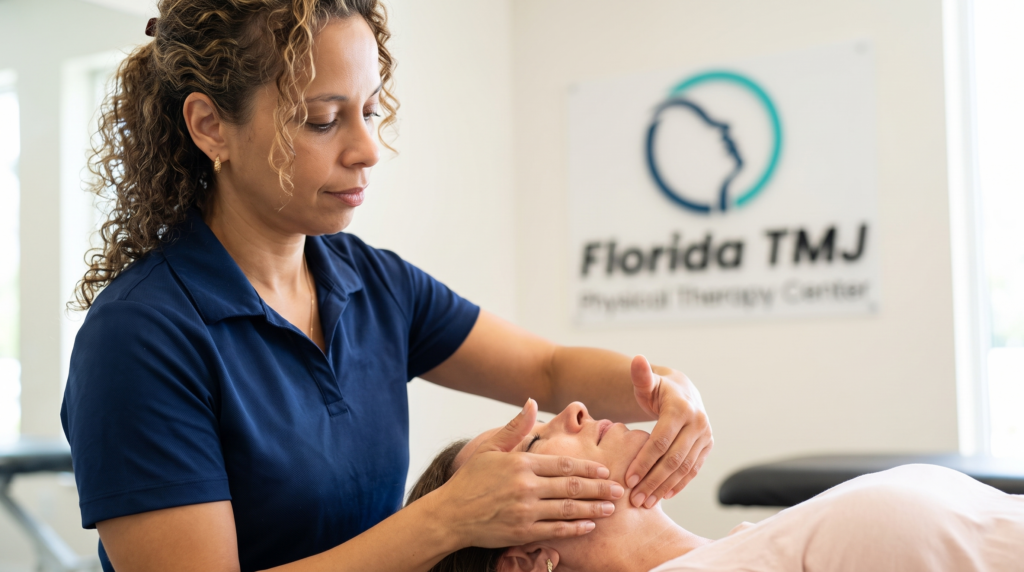
Where myofascial release for TMJ differs from general soft tissue work is access. The medial pterygoid and the deep fibers of the masseter sit where fingers on the outside of the face cannot reach them effectively. An intraoral (buccal) approach, working gently from inside the cheek, reaches those fibers directly. Patients who have tried massage, heat, and a night guard without much change are often the ones who respond to this, simply because the muscle doing the most work had never actually been treated.
The technique is slow and low-force by design. Jaw muscles guard when they are rushed, so pressure is held and eased rather than pushed.
TMJ Physical Therapy in Pembroke Pines
If you’ve been told your scans look normal but your jaw still hurts, you’re in the right place. TMJ and craniofacial pain is the entire focus of this practice, not one condition among many, and Dr. Evelyn Mora builds every plan around what your evaluation actually finds, manual therapy, targeted exercise, and the modalities that fit your case, all without surgery. We’d like to hear what’s going on.
How Correcting Jaw Alignment Supports Long-Term Relief
In physical therapy, to correct jaw alignment means changing the muscular and postural factors that determine where the jaw rests and how it travels, not altering the structural bite. Balancing muscle tone between the two sides and unloading a head-forward posture allows the joint to sit and move more symmetrically over time.
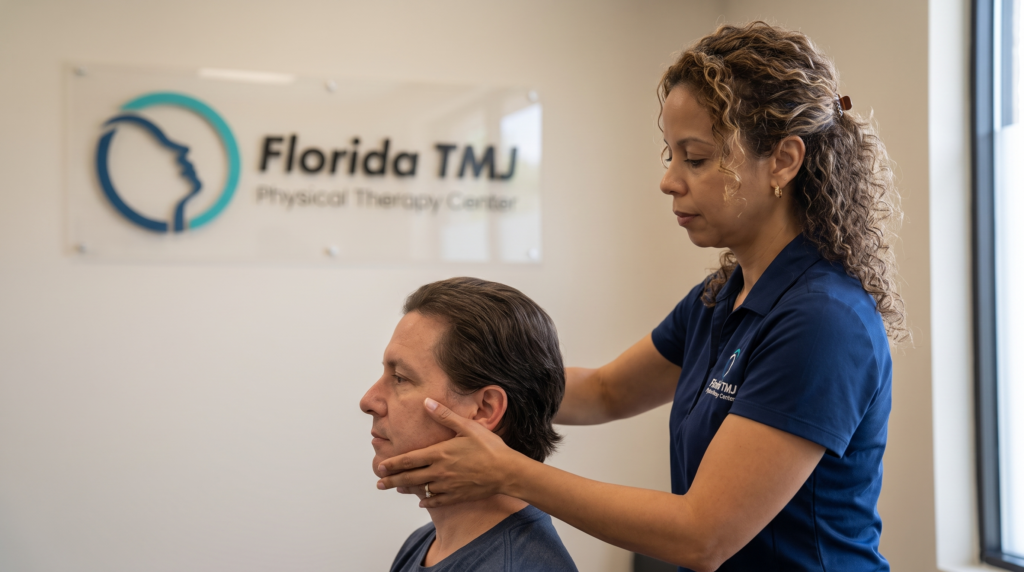
There is a resting position most people have quietly lost: teeth slightly apart, lips closed, tongue resting lightly on the roof of the mouth. Teeth are only meant to touch during chewing and swallowing, which adds up to a small fraction of the day. Patients with facial pain are frequently resting with their teeth in light contact for hours, which keeps the elevator muscles switched on continuously. Retraining that resting position, and the head and shoulder posture that supports it, is often what keeps relief from unraveling between appointments.
Why Collaborative Care Between PT and Dentistry Matters
Collaborative care matters because physical therapy and dentistry address different pieces of the same problem. Physical therapy treats muscle tension, fascial restriction, joint mobility, and postural contributors. A dentist or orthodontist addresses structural bite alignment and appliance therapy. Patients with both muscular and structural involvement generally progress faster when the two are coordinated.
This is why Florida TMJ Physical Therapy Center regularly receives referrals from dentists, orthodontists, and oral and maxillofacial surgeons across Broward County. A night guard, for instance, can protect the teeth from grinding and reduce joint loading overnight, but it does not lengthen a shortened masseter or restore a restricted joint glide. Pairing the appliance with manual therapy addresses both the protection and the mechanics. You can read more about Dr. Mora’s specialized TMJ training and background and how that shapes the way she works alongside referring providers.
What Each Approach Addresses in TMJ and Orofacial Pain
| Approach | Muscle & Fascial Tension | Joint Mobility | Postural Contributors | Structural Bite Alignment |
|---|---|---|---|---|
| Specialized TMJ Physical Therapy | Yes | Yes | Yes | No (dental scope) |
| General Physical Therapy | Partial | Partial | Yes | No |
| Dental Appliance Therapy | Partial (protective) | Partial | No | Yes |
| Pain Medication Alone | No | No | No | No |
If facial pain, cheek soreness, or an ache that keeps getting mistaken for a tooth problem has been part of your routine for longer than it should be, the jaw is worth ruling in or out properly. Dr. Evelyn Mora, PT, DPT, provides non-surgical, individualized TMJ disorder treatment evaluations at Florida TMJ Physical Therapy Center in Pembroke Pines, FL. Schedule your TMJ and facial pain evaluation and find out what is actually generating the pain.
Frequently Asked Questions About TMJ Disorder Treatment
It can produce pain that feels like it is coming from the teeth. The masseter and temporalis refer to pain toward the upper and lower molars, which is why some patients complete a dental workup with no findings before the jaw muscles are examined.
Most techniques are low-force and gradual. Patients often describe a deep, working pressure during trigger point release, followed by looser jaw movement. Any soreness afterward tends to feel like post-exercise muscle soreness and settles within a day.
Intraoral release is manual therapy performed gently from inside the cheek to reach the medial pterygoid and deep masseter fibers. These muscles sit beyond the reach of external massage, so patients whose pain has resisted outside treatment often need this access.
Florida allows direct access to physical therapy, so a referral is not required to be evaluated. That said, coordination with your dentist or oral surgeon is welcome, and Dr. Mora regularly works alongside referring providers when structural and muscular factors overlap.
No. Physical therapy addresses the muscular, fascial, and joint-mobility components of TMD. Structural bite alignment falls under dental and orthodontic care. When both are involved, the two approaches are meant to run alongside each other, not replace one another.
That depends on how long symptoms have been present, how much joint restriction exists, and whether clenching or posture is still feeding the cycle. It is a question best answered after the evaluation, when those factors have actually been measured.