TMJ Trigger Points: Why Knots in Your Jaw Muscles Hurt
You press on your cheek and find a small, sore spot. A second later, the ache spreads into your back teeth or your ear. Many people feel this and assume something is wrong with a tooth. Often, though, the source is a tight band of muscle known as a trigger point. TMJ trigger points are common in people who clench, grind, or hold tension in the face. They can also be confusing, since the pain rarely stays where the knot is. This guide explains what these spots are, where they tend to form, and how we approach them in care.
TL;DR
- TMJ trigger points are tight, tender spots in the jaw muscles that can send pain to the teeth, ear, temple, or neck.
- The masseter, temporalis, and pterygoid muscles are the most common places for jaw trigger points to form.
- A trigger point in the masseter can feel like a toothache or ear pain, even when the teeth and ears check out fine.
- In our clinic, we combine dry needling, manual therapy, posture work, and home exercises in one plan.
- Gentle self-massage may help some people, but a full evaluation is the safest first step if pain keeps returning.
Why Does a Small Knot in Your Cheek Cause So Much Pain?
It seems strange that a spot the size of a pea could cause so much trouble. Still, the jaw muscles work hard all day. They help you chew, speak, swallow, and hold your mouth in place. When one area stays tight for too long, it can become very sensitive.
Pain from that spot also travels. Your brain gets signals from the jaw, face, teeth, and ears through shared nerve paths. As a result, it may misread where the pain begins. You feel the ache in a tooth or near the ear, while the true source sits in the muscle.
Many patients come to us after hearing that their X-rays look normal. That can feel frustrating. Dr. Evelyn Mora, PT, DPT, sees this pattern often in her TMJ-focused practice. In her experience, a careful hands-on exam of the jaw muscles can bring clarity when other tests do not.
What Are TMJ Trigger Points?
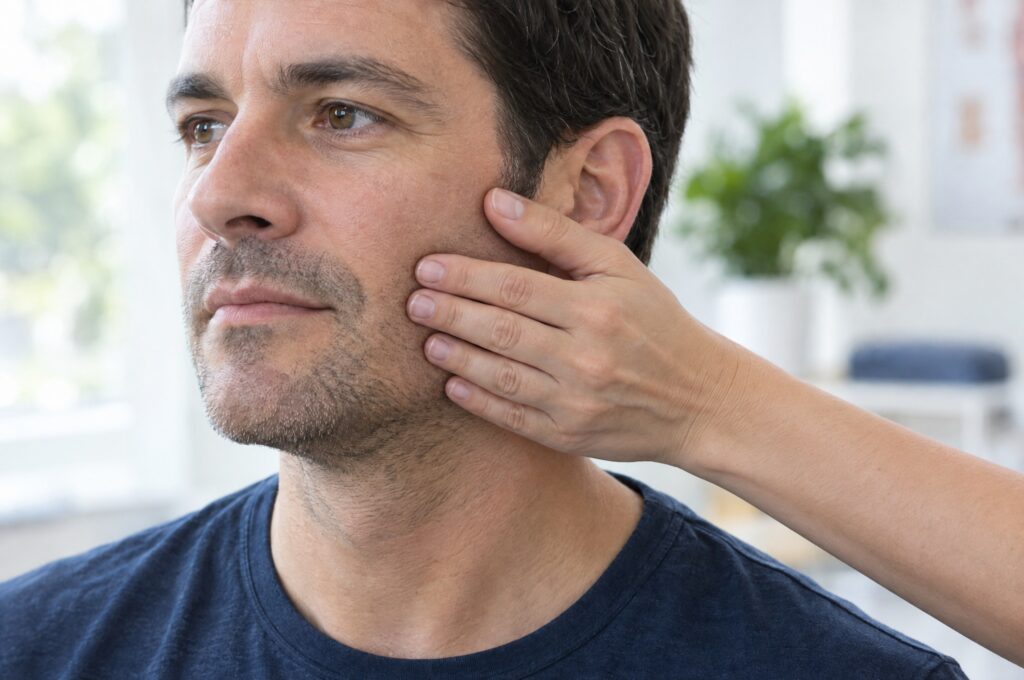
A trigger point is a small, tense spot inside a band of muscle. It often feels like a firm knot or a tender bump under the skin. When pressed, it may cause a dull ache that spreads to another area. Clinicians call this spread “referred pain.”
TMJ trigger points form in the muscles that move and support the jaw joint. They are a common part of myofascial pain, which is one of the most frequent types of TMJ disorder. Researchers still debate exactly how trigger points form. However, most agree that steady muscle overload plays a role.
Common Habits That Load the Jaw Muscles
Several daily habits can keep these muscles working without rest:
- Clenching or grinding the teeth, day or night
- Chewing gum, ice, or hard foods often
- Resting the chin on a hand at a desk
- Forward head posture while using phones or screens
- Stress that shows up as a tight jaw
Not everyone with these habits develops pain. Even so, they are worth noticing, since they often appear in the history of people with jaw trigger points.
Where Jaw Trigger Points Usually Form
Jaw trigger points tend to appear in a handful of muscles. Each one has a typical pain pattern. Knowing these patterns helps explain why symptoms can show up in places that seem unrelated.
| Muscle | Where It Sits | Where Pain May Be Felt |
| Masseter | Side of the cheek, over the back teeth | Upper or lower molars, jaw angle, ear, eyebrow area |
| Temporalis | Side of the head, above the ear | Temples, upper teeth, behind the eye |
| Lateral pterygoid | Deep inside, in front of the joint | Jaw joint, cheekbone, sinus area |
| Medial pterygoid | Inside the back of the jaw | Inner ear, throat area, back of the mouth |
| Upper trapezius and SCM | Neck and upper shoulder | Temple, jaw angle, side of the face |
The neck muscles belong on this list for a reason. The jaw and neck work as a team. When the head sits forward, the neck muscles strain, and the jaw often follows. For that reason, we check both areas in every evaluation.
The Trigger Point Masseter Link to Tooth and Ear Pain
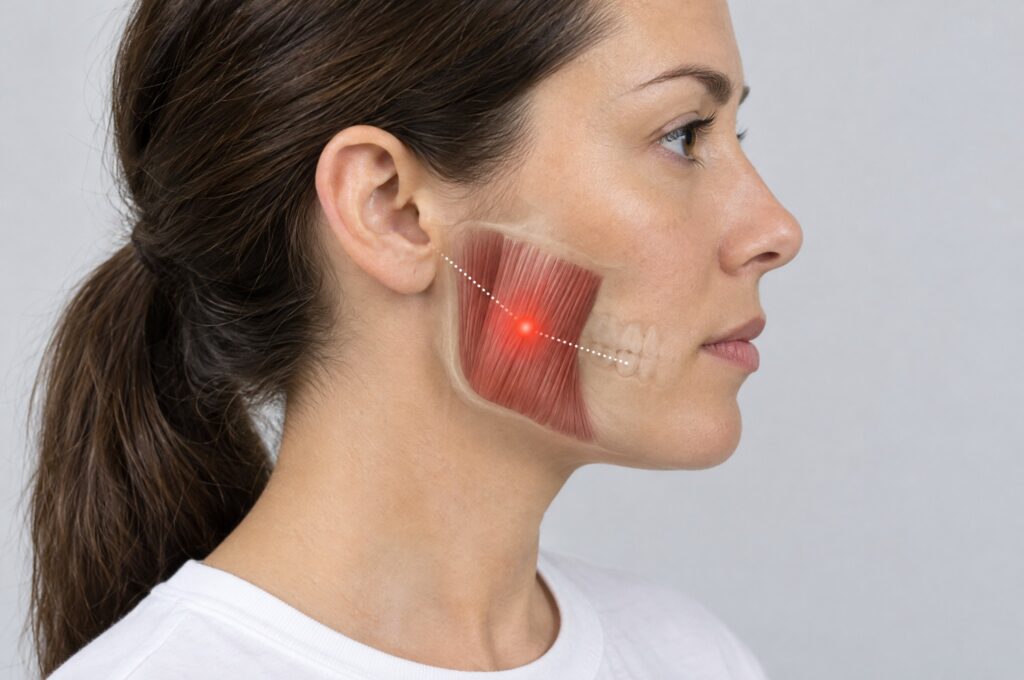
The masseter is one of the strongest muscles in the body for its size. You can feel it bulge at the side of your cheek when you bite down. Because it works so hard, it is a very common site for trigger points.
A trigger point masseter pattern often shows up as tooth pain. People may feel an ache in the upper or lower molars. Some notice that their teeth feel sensitive to pressure or cold. In many cases, a dentist checks the teeth and finds no problem at all.
Ear symptoms are also common. A trigger point deep in the masseter may cause an ache near the ear. Some people describe a feeling of fullness. Others notice a mild ringing that seems to change when they move the jaw.
It is important to rule out dental and ear problems first. Your dentist and physician should check those areas. After that, a TMJ-focused physical therapist can look at the muscles. You can learn more about these links on our related conditions page.
How We Treat Trigger Points With Dry Needling and Manual Therapy
Every plan at our clinic starts with an evaluation. Dr. Mora looks at how your jaw opens and closes, how your neck moves, and how you sit and stand. She also feels each jaw muscle to find tender spots and pain patterns. From there, she builds a plan around what she finds.
Dry Needling
Dry needling uses a very thin, solid needle placed into a tight muscle band. The goal is to help the muscle release tension and to calm pain signals. Many patients feel a brief twitch or a deep ache during treatment. Afterward, the area may feel sore for a day or so. Dr. Mora holds a certification in dry needling and uses it as one part of a larger plan. You can read more in our guide to dry needling for TMJ pain relief.
Manual Therapy
Hands-on work is a core part of care. This may include gentle pressure on trigger points, muscle stretches, and soft tissue work inside or outside the mouth. Joint movement techniques can also help the jaw glide more easily.
Supporting Care
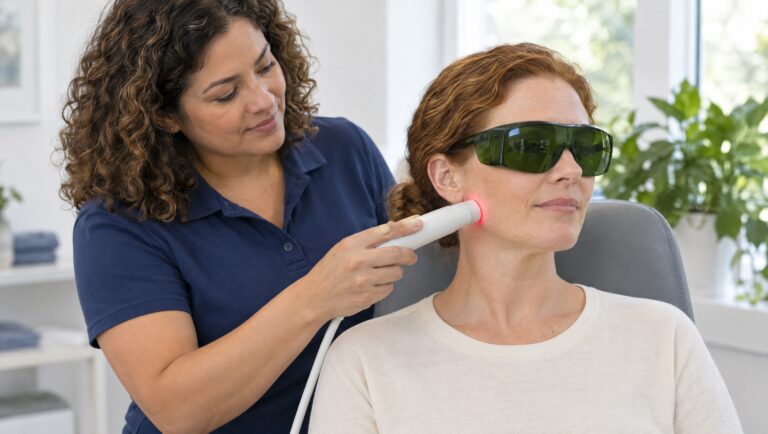
Other tools may round out the plan. These can include posture correction, home exercises, laser therapy, ultrasound therapy, or electrical stimulation. We also teach you to notice clenching habits during the day. Together, these steps are designed to ease the load on your jaw muscles over time.
Is TMJ Trigger Point Massage Safe to Try at Home?
For many people, gentle TMJ trigger point massage is a reasonable thing to try. It may ease mild muscle tightness between visits. Still, a few ground rules help keep it safe.
Simple Guidelines for Self-Massage
- Use light to moderate pressure with two fingertips.
- Make small, slow circles over the sore spot for about 30 to 60 seconds.
- Keep your teeth slightly apart and your jaw relaxed.
- Stop if the pain turns sharp, spreads quickly, or causes numbness.
- Skip the area if it looks swollen, red, or feels warm.
More pressure is not better. Pressing hard can irritate the muscle and leave it more sore the next day. A short, gentle routine done often tends to feel better than a long, deep one.
Self-massage also has limits. It does not address the habits, posture, or joint mecfhanics behind the pain. If the knots keep coming back, that pattern is worth a closer look.

When to Have Your Jaw Muscles Evaluated
Some jaw soreness fades on its own after a stressful week. Other times, it lingers or keeps returning. Consider an evaluation if you notice any of the following:
- Jaw, tooth, or ear pain that lasts more than a few weeks
- Pain that returns after your dentist finds no dental cause
- Clicking, popping, or a jaw that feels stuck
- Headaches that seem to start in the temples or jaw
- Trouble opening your mouth fully or chewing comfortably
At Florida TMJ Physical Therapy Center, TMJ and craniofacial pain is our entire focus. Dr. Mora brings over 10 years of clinical experience, including 8 years at Memorial Hospital West. She also trained in TMJ disorders under leading names in the field. Our small, calm practice gives each patient time to ask questions and understand the plan.
If you live in Pembroke Pines or anywhere in Broward County, we would be glad to help. Call us at (954) 636-5760 or contact us to schedule your evaluation.
Ask About Dry Needling for Tight Jaw and Neck Muscles
When the muscles around your jaw, neck, and shoulders stay locked in tension, stretching alone often isn’t enough to settle them down. Dry needling targets those trigger points directly, and Dr. Evelyn Mora uses it alongside hands-on therapy and exercise as part of one individualized plan. If you’re curious whether it fits your case, an evaluation is the place to start.
Frequently Asked Questions
They often feel like a small, firm knot or a tender band in the cheek, temple, or neck. Pressing on one may cause a dull ache that spreads to the teeth, ear, or side of the head.
Yes, they can. Trigger points in the masseter and temporalis muscles commonly send pain to the upper and lower teeth. It is still important to have your dentist rule out a dental cause first.
It varies from person to person. Some people notice changes within a few visits, while others need a longer plan. Your therapist can give you a better sense of this after an evaluation.
Most people feel a quick pinch, a muscle twitch, or a deep ache during treatment. Mild soreness for a day or so afterward is common. Your therapist will check in with you throughout the session.
Gentle daily massage is fine for many people if it feels comfortable. Keep the pressure light and the sessions short. Stop if pain becomes sharp or you notice numbness or swelling.
In Florida, many patients can see a physical therapist without a referral for a set period of time. Insurance plans have their own rules, so call our office to check your coverage.