What You Need To Know Between Migraines and Jaw Pain
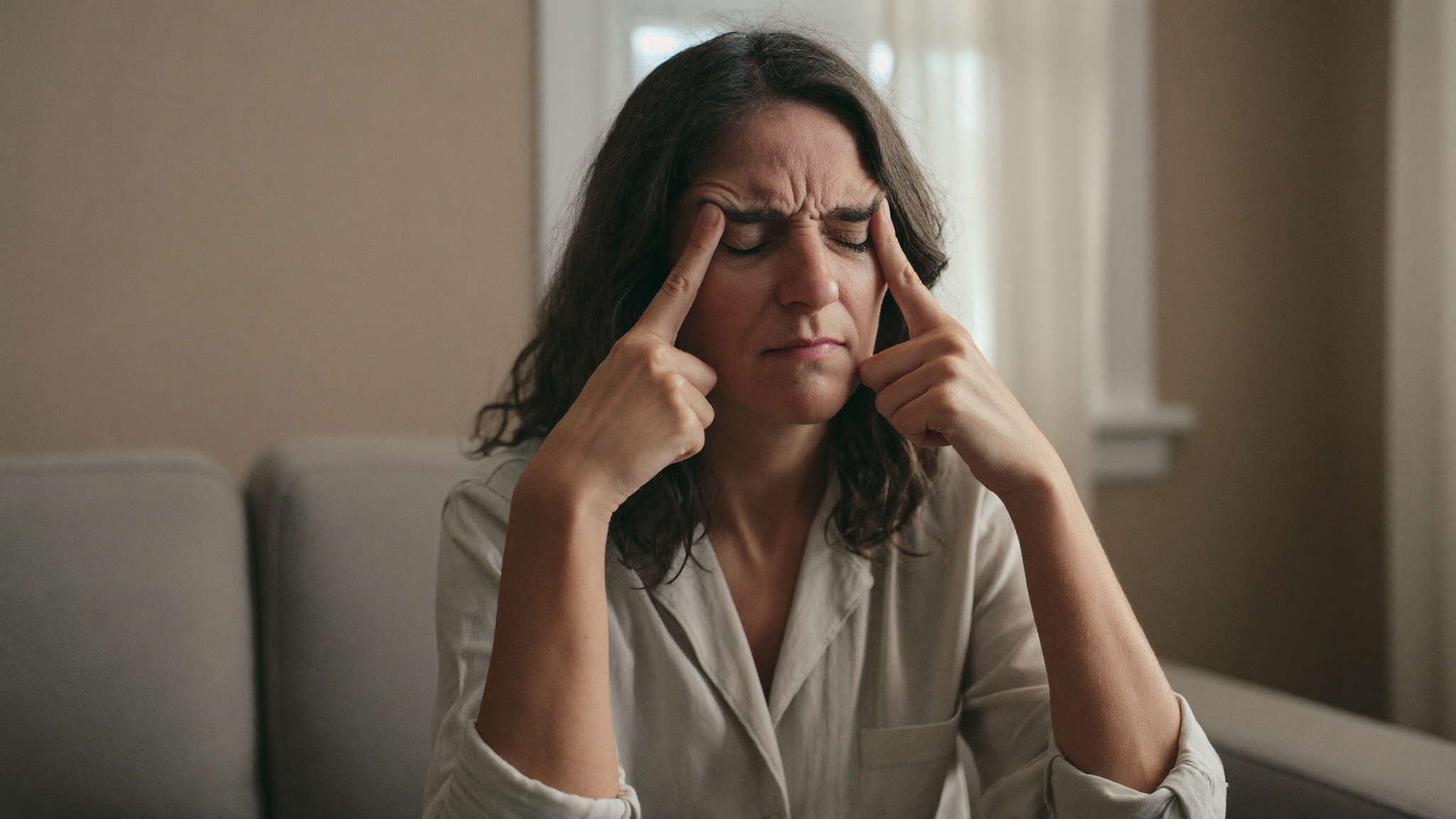
By the time most people start wondering whether their headaches have anything to do with their jaw, they have already tried a lot of other things. Prescription medication. Cutting out red wine, then coffee, then cheese. Tracking sleep, screens, and weather fronts. And somewhere in the middle of all that, they notice something odd: the bad headache days are also the days their jaw feels tight, or sore after breakfast, or clicks when they yawn. Migraines and jaw pain turning up together this consistently is not a coincidence, and the relationship between them is more two-directional than most people are told.
TL;DR: Jaw dysfunction and migraine share nerve pathways, so each can amplify the other. TMJ problems can act as an ongoing trigger that makes migraines easier to set off, and an active migraine can make the jaw and face feel sore on its own. Physical therapy does not treat migraine itself, but it can remove the jaw-related driver that keeps feeding it. Sorting out which is which starts with an evaluation.
Could Your Migraines Actually Be Coming From Your Jaw?
Jaw dysfunction does not cause migraine, but it can act as a peripheral trigger that makes migraine attacks more frequent and easier to provoke. The trigeminal nerve supplies both the jaw muscles and the pain-sensitive structures involved in migraine, so persistent input from an irritated jaw feeds the same system that generates the headache.
That shared wiring is why so many patients spend a long time in the wrong lane. Dr. Evelyn Mora, PT, DPT, who trained specifically in TMJ disorders and craniofacial pain, sees patients regularly who have had years of headache treatment without anyone examining the jaw, even though the masseter and temporalis were tender to the touch and the mouth would not open fully. The headache was real and the treatment was reasonable; the contributing factor sitting alongside it had simply never been assessed.
How TMJ Dysfunction Triggers Headaches and Migraines
TMJ dysfunction contributes to headache through two routes. Overworked jaw muscles refer pain directly into the temple, behind the eye, and toward the base of the skull. Separately, sustained input from those muscles and from the joint can sensitize the trigeminal system, lowering the threshold at which a migraine attack is triggered.
The referral route is straightforward once you see the pattern. The temporalis, which fans across the side of the head above the ear, refers pain into the temple and toward the upper teeth. The masseter refers to the cheek and jaw angle. The lateral pterygoid, sitting deep behind the jaw, refers to the region behind the eye, which is exactly where many people describe their worst headache pressure.
The sensitization route is less visible but matters more for anyone with diagnosed migraine. Constant low-grade input from clenching, grinding, or a restricted joint keeps the trigeminal system busy, and a system already running warm takes less to tip over. The upper cervical segments (C1 through C3) converge with the trigeminal nerve at the same relay, which is why neck stiffness so often rides along.
So, can migraines cause jaw pain in the other direction? They can. During an attack, central sensitization can make the face and scalp tender to ordinary touch, and many people clench through the pain, which leaves the jaw sore afterward. That is one reason “which came first” is often the wrong question to get stuck on.
Recognizing Jaw Tightness and Headache-Related Symptoms
The most useful clues are the symptoms that sit alongside the headache rather than the headache itself. Morning jaw tightness, fatigue or aching after chewing, clicking or popping, ear fullness without infection, and tenderness when pressing the cheek or temple all point toward jaw involvement worth evaluating.
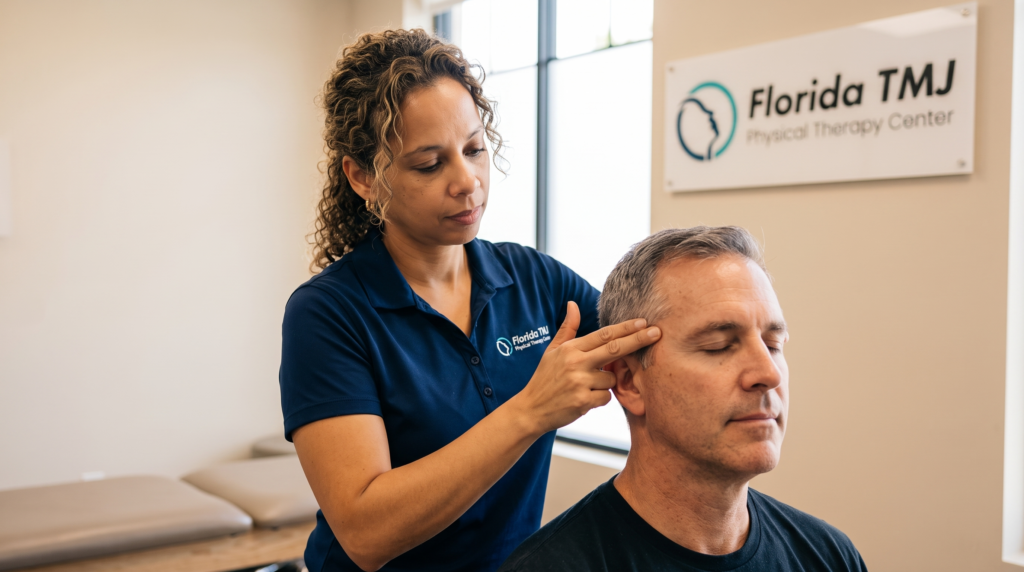
Timing is informative too. Headache and jaw tension that is worst on waking often points toward overnight clenching or grinding. Pain that builds through the afternoon, after hours of desk posture and talking, points more toward muscular fatigue and postural load. Migraine has its own signature features, including light and sound sensitivity, nausea, and a distinct build and resolution, and those features can coexist with jaw findings rather than ruling them out.
A simple self-check: press firmly with two fingers into the muscle just above your ear, then into the cheek muscle about an inch in front of your earlobe, then clench and release. If any of that reproduces a familiar headache sensation rather than just local soreness, the jaw is worth ruling in or out properly. Several of the symptoms that trace back to jaw dysfunction surface exactly this way.
Headaches That May Be Coming From Your Jaw
Many of the patients we see have been treating headaches for years without anyone looking at the jaw or the neck. Tension-type and cervicogenic headaches are often tied to TMJ dysfunction and cervical spine involvement, and our approach combines manual therapy, postural work, and targeted exercise to address what’s driving them. We’d be glad to take a closer look with you.
How Physical Therapy Addresses Migraines and Jaw Pain Together
Physical therapy does not treat migraine as a neurological condition. What it addresses is the jaw and cervical contribution feeding into it: releasing trigger points in the temporalis, masseter, and pterygoids, restoring jaw and upper neck mobility, and correcting the postural patterns that keep reloading those tissues.
Being precise about that boundary matters. A patient with diagnosed migraine and significant TMD has two things happening, and treating the jaw addresses one of them. What patients often report is not that the headaches disappear, but that they arrive less easily and settle faster once the constant jaw input is reduced. That is a meaningful outcome, and it is an honest one to describe.
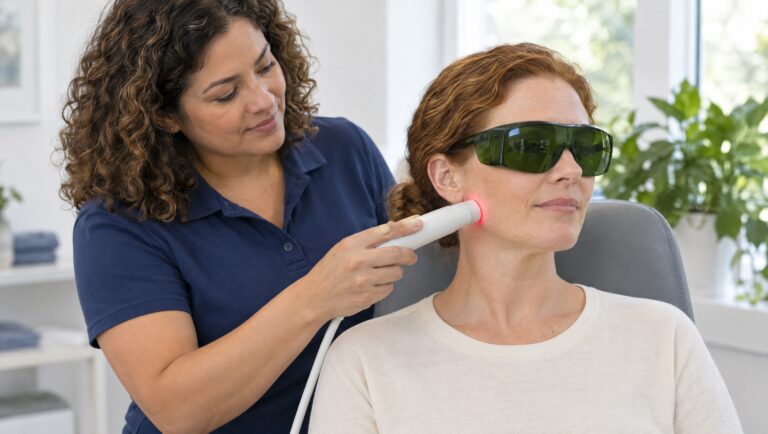
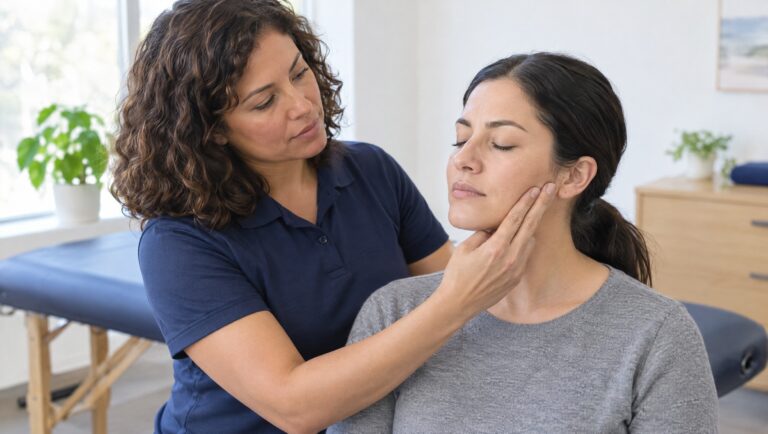
Treatment usually combines manual therapy for the jaw and neck, dry needling where trigger points are reproducing familiar headache pain, upper cervical mobility work, and postural retraining. Intraoral (buccal) release is often part of it, since the medial pterygoid and deep masseter sit beyond the reach of external massage. Our approach to headache management for jaw-related head pain is built around exactly this combination, and for patients whose head pain is the primary complaint, the five methods we use for TMJ headache relief go into more depth on each technique.
Distinguishing Features: Migraine vs. Jaw-Related Headache
| Feature | More Typical of Migraine | More Typical of Jaw-Related Headache |
|---|---|---|
| Onset pattern | Distinct attacks with build and resolution | Gradual, often daily or near-daily |
| Time of day | Variable, can wake from sleep | Worst on waking or late afternoon |
| Associated symptoms | Nausea, light and sound sensitivity, aura | Jaw clicking, ear fullness, chewing fatigue |
| Response to jaw movement | Usually unchanged | Often provoked by chewing or clenching |
| Muscle tenderness on palpation | May be present during attack | Reproduces the familiar headache |
| Note | The two frequently coexist; findings here are indicative, not diagnostic | [verify PAA/FAQ phrasing] |
At-Home Tips for Easing Headache and Jaw Tension
Simple daily habits can reduce the jaw-related load contributing to headaches. The most effective are jaw awareness through the day, a neutral resting position for the tongue and teeth, heat before bed, and attention to screen height and sleep posture. These support treatment; they are not a substitute for evaluation when headaches are frequent.
Notice the clench. Teeth are only meant to touch during chewing and swallowing. Set a phone reminder a few times a day and check where your jaw is. Most people are surprised.
Find the resting position. Tongue tip lightly on the roof of the mouth just behind the front teeth, teeth slightly apart, lips closed. Return to it whenever you catch yourself clenching.
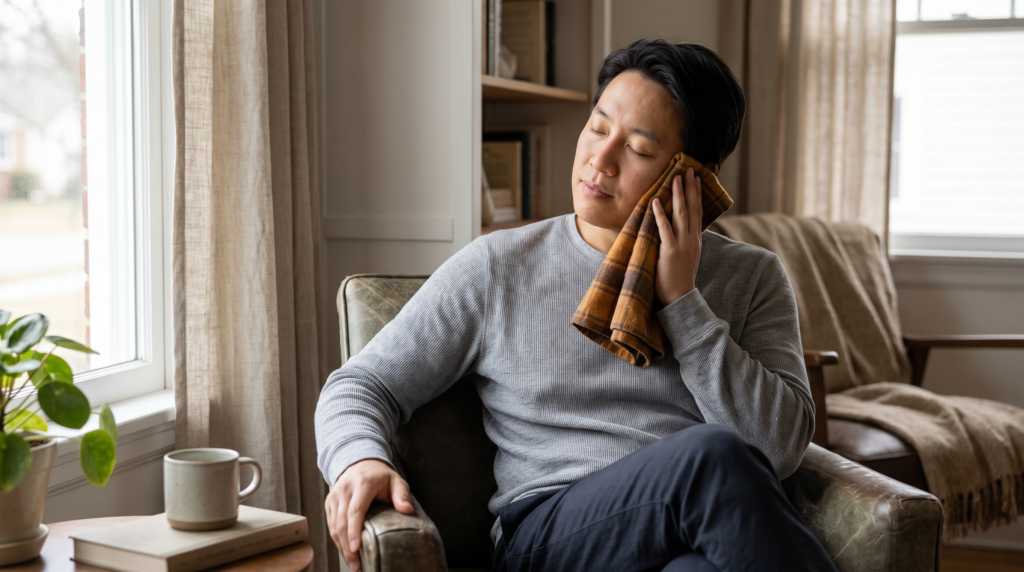
Use heat, not force. A warm compress along the jawline for ten minutes before bed relaxes the closing muscles. Avoid aggressive self-massage or forcing the mouth open wide, which usually increases guarding.
Soften the chewing load during flares. Gum, chewy bread, and hard raw vegetables ask a lot of muscles that are already fatigued. Easing off for a week during a bad stretch is reasonable.
Fix the screen and the pillow. Raise the monitor so the top third sits at eye level, and avoid stomach sleeping, which rotates the neck and presses one side of the jaw into the pillow for hours.
Finding Relief When Migraines and Jaw Pain Are Connected
When migraines and jaw pain occur together, the practical goal is to identify and reduce every contributor that can be reduced. Headache care may continue with your physician or neurologist while physical therapy addresses the jaw and cervical component, and coordinating the two tends to produce better results than pursuing either alone.
What that looks like in the clinic is a measured baseline rather than a guess. Maximal mouth opening in millimeters, whether the jaw deviates as it opens, which muscles reproduce familiar headache pain when palpated, and how the upper neck moves. Those findings shape the plan and give something concrete to track, since headache frequency alone fluctuates with too many other variables to judge treatment by.
If your headaches keep arriving alongside jaw tightness, clicking, or soreness after meals, that overlap is worth investigating rather than working around. Dr. Evelyn Mora, PT, DPT, provides non-surgical evaluations for jaw-related head pain at Florida TMJ Physical Therapy Center in Pembroke Pines, FL, assessing jaw mechanics, muscle involvement, and cervical posture together. Schedule your jaw and headache evaluation and find out how much of the picture your jaw is carrying.
Frequently Asked Questions About Migraines and Jaw Pain
TMJ dysfunction does not cause migraine, but it can act as a peripheral trigger. The trigeminal nerve supplies both the jaw muscles and the structures involved in migraine, so ongoing input from an irritated jaw can lower the threshold at which attacks are provoked.
Yes. During an attack, central sensitization can make the face, scalp, and jaw tender to normal touch, and many people clench through the pain. That combination leaves the jaw sore afterward even when the jaw was not the original trigger.
Look for what accompanies it: morning jaw tightness, clicking, ear fullness, or fatigue when chewing. If pressing the temporalis or masseter reproduces a familiar headache sensation rather than plain soreness, jaw involvement is worth evaluating.
Physical therapy treats the jaw and cervical contribution, not migraine itself. Patients with both often report attacks that are less easily provoked once jaw input is reduced. Migraine management should continue with your physician or neurologist alongside treatment.
If you have diagnosed migraine, keep your neurologist involved. Add a TMJ evaluation when jaw symptoms are present alongside the headaches, since that contribution is treatable independently and often goes unassessed for years.
A night guard protects the teeth and can reduce overnight joint loading, which helps some patients. It does not lengthen shortened jaw muscles or restore restricted joint movement, so it is generally more effective paired with manual therapy than used alone.