
Can TMJ Cause Neck Pain? Understanding the Connection
Your neck has been stiff for months. You have stretched it, swapped pillows, and maybe seen someone about it. Relief arrives, then it fades. Meanwhile your jaw clicks when you yawn, and chewing a bagel leaves you sore by lunch. Those two complaints feel unrelated, so most people treat them separately. Then a question surfaces: can TMJ cause neck pain, or are these simply two problems that showed up around the same time? The answer changes what treatment should target. Your jaw and your neck are not neighbors that happen to ache together. They share muscles, nerve pathways, and postural control, so each one shapes how the other works.
TL;DR: TMJ dysfunction can drive neck pain, and neck problems can drive jaw pain. The two regions share muscles and a nerve relay in the brainstem, which is why treating one alone often produces relief that keeps fading. An evaluation that examines the jaw and the neck in the same visit is what sorts out which side is leading.
Can TMJ Cause Neck Pain? The Short Answer
Yes. TMJ dysfunction can cause or worsen neck pain, because the jaw and upper neck share muscles, nerve pathways, and postural control. Treating only the neck often brings short-lived relief, since the jaw keeps reloading the same tissues. A proper evaluation checks both regions together rather than one at a time.
Dr. Evelyn Mora, PT, DPT, trained specifically in TMJ disorders and craniofacial pain, and she sees this pattern weekly. Patients arrive after months of neck-focused care. Their neck loosens for a few days, then tightens again. Nobody had checked the jaw, even though it clicked and would not open fully.
The link also runs the other way. A stiff upper neck can leave the jaw doing extra work, which is why some patients notice jaw symptoms only after a whiplash injury or a long stretch of desk work. Because of that two-way traffic, “which came first” is less useful than “which one is still driving it today.”
How TMJ Dysfunction Affects the Muscles in Your Jaw and Neck
The muscles in the jaw and neck work as one system. Jaw closers such as the masseter and temporalis coordinate with neck muscles like the sternocleidomastoid and upper trapezius to steady the head during chewing. When the jaw struggles, those neck muscles absorb the extra work.
Think about what happens every time you bite down. Your jaw pulls up against resistance, and something has to hold your head steady so the force goes into the food rather than into your skull. The neck extensors and the sternocleidomastoid handle that job. Chew all day with a painful joint, and those muscles put in a longer shift than they were built for.
Clenching makes it worse. Many people hold their teeth lightly together for hours without noticing, especially while concentrating. That low-grade contraction never lets the system rest, so the neck stays switched on alongside the jaw.
Why Muscles in Jaw and Neck Move as One Unit
Here is a detail most articles skip. Opening your mouth wide involves a small amount of neck extension, because the head tips back slightly as the jaw drops. That coupled motion is normal. Lose it, and the jaw has to produce the range the neck used to contribute.
In the clinic this shows up plainly. Measure how far someone can open with their head in its habitual forward position, then measure again with the head supported back over the shoulders. The number often changes. For a patient who has been told their jaw and neck are separate issues, watching that measurement shift takes about a minute and settles the argument.
Why Referred Pain Links Jaw and Neck Pain Together
Referred pain happens when the brain misreads where a signal started. Sensory fibers from the trigeminal nerve, which serves the jaw and face, converge with fibers from the top three cervical nerve roots on the same neurons in the brainstem. As a result, jaw input can genuinely register as neck pain.
That convergence point has a name, the trigeminocervical nucleus, and it explains a great deal. Signals from your jaw and signals from your upper neck arrive at the same relay before heading upward. The brain then has to guess at the source, and it guesses wrong often enough to send people to the wrong appointment for years.
Trigger points add another layer. Tight bands in specific muscles refer to pain along predictable maps. The sternocleidomastoid sends pain to the forehead and behind the eye, and it can produce a mild dizzy or off-balance feeling. The upper trapezius refers up the side of the neck toward the temple. The masseter refers to the jaw angle and the ear.
Notice the overlap. A jaw muscle and a neck muscle can produce almost the same pain map. So where you feel it tells you less than which muscle reproduces it under pressure. Several of the symptoms that trace back to jaw dysfunction get misfiled for exactly this reason.
Common Symptoms of TMJ Neck Pain
TMJ neck pain usually arrives as a cluster rather than a single complaint. Watch for neck stiffness alongside jaw clicking, pain that shifts with chewing or talking, limited mouth opening, shoulder tension that resists standard neck treatment, and headaches starting near the temple or the base of the skull.
A few patterns are especially telling. Neck pain that flares after a long meal or a day of heavy talking points toward the jaw, since that is when jaw muscles fatigue. Morning stiffness in both regions suggests overnight clenching or grinding. And neck treatment that helps briefly, then stops helping, usually means something else keeps reloading the tissue.
Ear symptoms belong on the list too. Fullness, pressure, or a sense of blocked hearing without any infection often traces back to the jaw joint and the muscles around it, because they sit directly in front of the ear canal.
Signs That Point to the Jaw vs. Signs That Point to the Neck
| What You Notice | Points More Toward the Jaw | Points More Toward the Neck |
|---|---|---|
| What provokes it | Chewing, yawning, clenching, long conversations | Turning the head, desk work, sleeping position |
| Joint sounds | Clicking or popping when opening | Usually absent |
| Mouth opening | Limited, uneven, or catches partway | Normally full |
| Accompanying signs | Ear fullness, cheek soreness, chewing fatigue | Arm or hand tingling, headache at the skull base |
| Response to treatment | Improves when jaw load drops | Improves with cervical mobility work |
TMJ Physical Therapy in Pembroke Pines
If you’ve been told your scans look normal but your jaw still hurts, you’re in the right place. TMJ and craniofacial pain is the entire focus of this practice, not one condition among many, and Dr. Evelyn Mora builds every plan around what your evaluation actually finds, manual therapy, targeted exercise, and the modalities that fit your case, all without surgery. We’d like to hear what’s going on.
How We Diagnose the Link Between Jaw and Neck Pain
Diagnosis means examining both regions in the same visit. The evaluation measures mouth opening in millimeters, tracks the path the jaw travels as it opens, palpates the jaw and neck muscles for pain that reproduces the patient’s usual symptom, and screens upper cervical mobility along with standing posture.
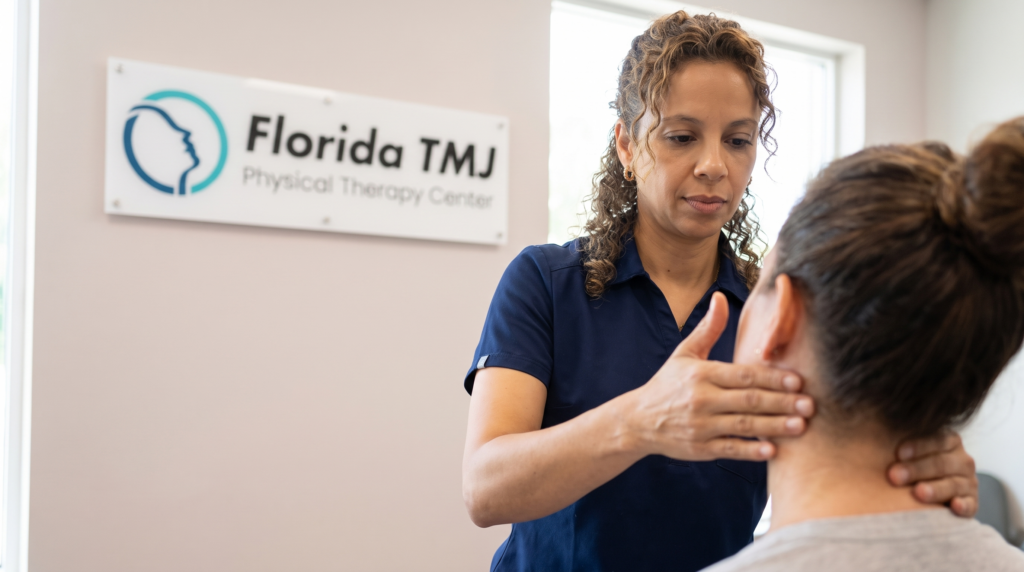
The reproduction test carries the most weight. Pressing a muscle and finding it tender proves very little on its own, since plenty of muscles are tender. What matters is whether that pressure recreates the specific ache the patient came in with. When a firm press on the sternocleidomastoid produces the familiar pain behind the eye, the source stops being a guess.
Numbers help as well. Opening range and jaw deviation stay steady from week to week, while pain scores swing with sleep, stress, and workload. For that reason the measurements guide the plan, and Dr. Mora adjusts treatment against them rather than against how the week felt. Our full write-up on how physical therapy for jaw pain works walks through that evaluation-first sequence in more detail.
The exam also screens for problems physical therapy should not be treated alone. Signs of an inflammatory joint condition, a structural bite issue, or nerve involvement in the arm get referred to the right provider instead.
Treatment Options for TMJ Neck Pain Relief
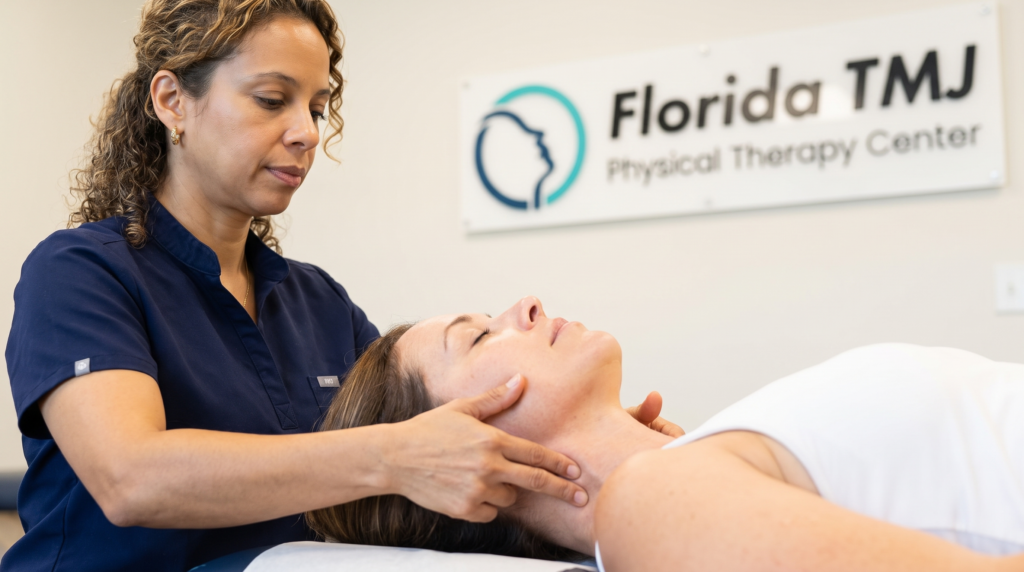
Treatment addresses the jaw and the neck within one plan. Manual therapy and trigger point work release the overloaded muscles, joint mobilization restores movement in the jaw and upper cervical spine, and postural retraining lowers the daily load that keeps both regions irritated.
Hands-On Work for Both Regions
Manual therapy comes first for most patients. The therapist releases the masseter, temporalis, sternocleidomastoid, and upper trapezius, then mobilizes the jaw joint and the upper cervical segments. Intraoral release reaches the medial pterygoid and deep masseter fibers, which sit beyond the reach of any outside massage.
Modalities That Support the Manual Work
Dry needling suits patients whose trigger points clearly reproduce their pain. Laser therapy helps when inflammation dominates. Ultrasound and electrical stimulation ease muscle guarding and stiffness. None of these replaces the hands-on work or the exercise; each one makes the rest more comfortable to tolerate.
Exercise and Posture
Then comes the part that holds the gains. Deep neck flexor strengthening, shoulder blade work, and chin tucks rebuild the support the head lost. Structured posture correction addresses the desk setup, phone habit, and sleep position feeding the cycle. Jaw awareness training interrupts daytime clenching before it reloads everything.
Progress usually looks gradual rather than sudden. Opening range widens, chewing gets easier, and the neck stops tightening back up within days of each session.
If your neck keeps stiffening no matter what you try, and your jaw clicks or aches alongside it, that overlap deserves a proper look. Dr. Evelyn Mora, PT, DPT, provides non-surgical evaluations for jaw and neck pain at Florida TMJ Physical Therapy Center in Pembroke Pines, FL, assessing both regions together. Schedule your jaw and neck evaluation and find out which one is actually driving your symptoms.
Frequently Asked Questions About TMJ and Neck Pain
Yes, and one-sided symptoms are common. Most people chew more on one side and many sleep with the head rotated, so one jaw joint and the muscles around it carry more load. That asymmetry shows up as neck pain concentrated on the same side.
Sometimes, though it depends on which region is driving the problem. Cervical treatment helps when the neck is the main source. When the jaw is the driver, neck work brings short-term relief that fades, because the jaw keeps reloading the same muscles.
Watch what provokes it. Neck pain that flares after chewing, long conversations, or clenching points toward the jaw. Jaw clicking, limited mouth opening, or ear fullness alongside the neck pain strengthens that picture and is worth having evaluated.
It can contribute. The upper trapezius spans the neck and shoulder and works alongside the jaw muscles to stabilize the head. When it stays overloaded, patients often report shoulder tension that does not respond to typical shoulder treatment.
A night guard protects the teeth and can reduce overnight joint loading, which helps some patients. It does not lengthen shortened jaw muscles or restore lost joint movement, so it generally works better paired with manual therapy than used by itself.
That depends on how long symptoms have run, how much joint restriction exists, and whether clenching or posture still feeds the cycle. Those factors get measured during the evaluation, which is a more honest basis for a timeline than a general estimate.
Usually not, though a few adjustments help. Heavy lifting often involves jaw clenching, and some gym positions push the head forward. Mentioning your routine during the evaluation lets your therapist suggest changes rather than asking you to stop.